Thursday, 18 April 2013

The head leads and the body follows

Within the Alexander Technique we have the expression "head leads and the body follows." The term itself was coined by researcher Rudolf Magnus (1873-1927) in his studies of posture in mammals he found that the head and neck reflexes of mammals cause the body to follow automatically when the head moves.

When we ride, or drive horses, we have control over the horse's head through the head stall. Depending on the task we want the horse to do, the head stall can be a halter or bridle with or without bit.

But the term "the head leads and the body follows" has also a psychological bearing, the brain leads and body follows. Training and education is a coin with two sides, a physiological and a psychological and to get the best effect of training and education these two needs to coincide.I found an image illustrating the two sides of the coin in Hans von Blixen Fineckes book The Art of Training. 


It is a simple image that contains a lot of information. Interesting to me as an Alexander teacher is that he's talking about the conscious brain of both horse and rider. He describes how the motoric action that constitutes our aids is recorded by the horse's sensory nervous system. The information from us to the horse goes through touch and the information from the horse is conveyed to us through feel.
 
Hans von Blixen-Finecke talking about riding as a language of touch and a prerequisite for this form of communication is calm, within both horse and rider. Calm and presence.

A friend who has vast experience of riding young  race horses think the most important thing in any form of training of horses is that the horse never gets frightened during the early training. It gets a positive attitude to the rider and the work it should do, it will feel safe and it makes the psychological side of the coin interact with the physiological in a beneficial manner. A calm horse can digest information from the rider, a scared and nervous horse is blocked.

 Another friend was at a jumping competition at the weekend and reported with a tired tone that few were actually riding, most engaged in trying to control flight responses with both bit, extra reins and BF&I (brute force and ignorance). The BF&I riders had certainly gained control over the horse's head mechanically but they had totally missed getting the horse mentally.
 
It is important for us as riders to be in a good balance within ourselves. As we sit on the horseback our own internal weight distribution (skewness) affects the horse's body. Somehow the horse must handle adding our weight to its own and distribute it over his feet. The more equilateral and straight we are aligned around our own spine, the more even our weight is distributed to the horse.

When we ride, and I assume that we are aware of our own bodies, it is the shift in the horse's balance we feel through both seat and hands. The shift signals to us if the horse is in a good self carriage in the current movement.. An untrained, uneducated or a horse that is under rehabilitation have more obvious shifts in the balance than a healthy and more educated horse. By being present in each step, we as riders are able to feel how the horse move and we can with our signals, our touch, give aids that help the horse to place the weight and regain balance.

A good education ultimately leads to an equipage that makes everything look easy, it's two brains joined in movement and although it is the rider who leads it is the sence of trust developed in the relationship that makes the horse participate without fear. At this point the rider can be said to ride the horse's conscious brain and in that context, the rider, if the he/she would like, can remove all the equipment from the horse and ride on.

Thursday, 4 April 2013

Perception - to hear the unspoken

Easter holiday and wonderful northern spring means that the blog has had to wait until sunset. The challenge is to capture the good days as a buffer for days of another kind.
In August 2010, I was out riding my anglo-arabian mare. We were out in the woods and rode on nice, gallop friendly sandy pine moore paths and I was so happy. She was alert, responsive and felt wonderful. One day I climbed her up a slight slope, four steps, we took the little slope twice - eight steps all in all.
We walked home and she went from calm and at ease to toss her head and stepping, she became generally annoying. I halted and thought that she would come to her senses, but she began to back up, and in the middle of a forced step back I felt how she lost her left hind leg. I got off her back and started walking home. Confused.
A few years later an acquaintance told me that she, after having taken a course on horses and bits, realized that the bit she liked to use when riding caused the most pain in the horse's mouth. It was incomprehensible to her, she felt that the horse was so soft and smooth in riding.
Another told me that they had discovered that the horse had lesions in the mouth but in riding the horse had felt soft and flexible. Another told me that the horse worked like a dream just to show lameness the day after.
Once is once but twice, three times, four times ... I know that this is not a statistically significant number, but never the less it raises a question in me. How well can we read horse?
Horses have utilized silence as their survival strategy, they are experts at hiding pain and the effects pain have on their bodies. Could it be that all the horses in these examples had showed small signals that something was wrong and since we as riders did not notice them, they moved within their frame of pain, and we considered them pliable and soft?
In my own case, I had taken her outside her framework under and she became very vocal in her behavior.
Had it been possible to discover pain reactions of the horses in the examples above by using a heart rate monitor? Were there some small indications from the horses' side that we missed, were there some big?
It is said that before you judge a horse to be disobediet, you should ask yourself if it understands what you ask for, if it has been trained to do what you ask for, or if it is physically fit to do what you ask for. You can tell by my wording that the way I reasoned in 2010 was disobedience - she was annoying and needed to come to her senses. The fact that it was the pain became apparent to me later, but at the moment disobedience was a closer option.
I have learned a lesson from the incident with my mare. Now I strive to ask me if it can be any of the other reasons that prevent the horse to do what I want instead of disobedience. I'm trying to train my perception, my ability to read horses better.
My new mare, whose feet carried me to AEP, enjoys the benefit of my homework and is also a good teacher. She signals in an ascending scale if I get too close to the edge of her frame of pain. In our training I don't not ask for any gait other than those she chooses to take in the pasture (the scare canter is not included). She has just recently begun to take a trot based on self carriage rather than a trot she jumped into. So we have now added short trot repetitons in our walks. We can take walks up to 1.5 hours, when we started she wanted to turn around after 10 minutes which added up to 20 minutes walk.
When we worked from the ground in a shoulder-in like move one step with left hind was enough in the beginning, one more and she gently nibbled my hand. Now we can take a series of steps in the corners. I propose a move and she adopts or rejects. It is not a question of obedience or disobedience to me, I trust that she knows what she is capable of doing and if I ask for more than she can manage so she shows me.
I see that she trained when she moves in the pasture. She's doing nice rollbacks on the narrow path where the gelding, who can not, must detour into the deep snow. The trot she offers now I long to ride. I really long to ride her, but I'm willing to give her the time she needs to heal. We do this together, she and I, we are a team.

Friday, 22 March 2013

Hooves and humans


It was a busy day yesterday with Vasaloppet for the children and that altered the writing schedule for me, but with that done, I can say that now it's finally spring!

Last spring a new horse came to my farm and she forced me to pay attention further down her legs to the hooves or more accurately to her feet. I have a good friend who dived into Jamie Jackson and Pete Ramey's wild horse model and one that focused on Applied Equine Podiatry (AEP). During the summer last year, I talked to both and juggled my thoughts about the new horse's hooves with them. For it soon became apparent that the traditional blacksmith could not come up with any solution that seemed sensible - or if I'll be completely honest, the farrier I contacted with a veterinarian referral was quote "so tired that he went home instead" end quote. After a response like that, it felt like I myself is my own best farmhand although I actually had big gaps in my knowledge.

At first I thought that my two friends had a similar vision of what was needed in terms of trimming, support and stimuli of the feet. I read about both their perspective and tried to insert my own horse's troubles in each framework. We struggeled on the horse and I, and although it was in small steps we progressed.

In September last year, the opportunity to immerse myselves in AEP came and I took it. After that I realized that what on the surface may seem alike can differ tremendously when you go in depth. AEP is a method of hoof care based on universal scientific principles that apply regardless of whether it's hooves, bow and arrow or cars being discussed. Wild Horse model is based on studies of wild horses in their respective environments such as Mustangs in the U.S. or Brumbies in Australia but it is not based on studies of domestic horses and their living conditions.

In Sweden there was a veterinarian who made headlines when he, in an article in an Equestrian Magazine, pointed out the area that created the most problems for horses in general. Can you guess where he was pointing?
In a place just behind the withers above the horse's back - man in the form of a rider.

When the horse went from being a prey animal to become a domestic animal the price it had to pay for food and protection was their lives and health. We have used them in war, to ride on long and arduous hardship and we have shaped them into different breeds to enhance properties that have been beneficial to us.

When farriery developed into the profession it is today, it was in response to the increased demands on the horse as transportation vehicles, a vehicle that would work more in one day and on surfaces that were more "hoof unfriendly" in the form of rough dirt roads, cobblestone, wet clay and so on. Horse managment changed, horses were more tied up in stalls with the consequence that they often stood in wet beds instead of roaming freely in pasture. The science was under construction, industrialization was still in its infancy. What they knew was static, ie load during quiet standing, pull, push and levers.

The farriery met the requirements that were on a hoof of a horse standing still. When the horses were predominantly started being shod long periods of the year, problems arose with ossification, white line disease etc. Everyone knew that it was because of the shoes, but they were seen as a necessary evil and a price you had to be willing to pay.

With industrialization came cars and the development of them brought dynamics, kinetic and now we have developed tools that enable accurate measurements of things that were previously hidden to the human eye.

The results of the scientific development is taken into consideration by AEP when the theory of the hoof and the horse's feet were designed. With the model that constitutes the AEP's basis for the work with horses' hooves and feet  I lcan earn to read a hoof at any time, wild or tame, and see if it is healthy or have defects in the structures. It's like a new world opening up!

Join course and get a new relationship with your horse's hooves!

Thursday, 7 March 2013

Winter can be a challenge to horse health

Winter is a time that can lead to an increased risk of colic. Colic is a general term for gastro-intestinal problems in horses and in a previous post, you can take a look at the horse's digestive system.

The increased risk of gastrointestinal problems comes from the quality of forage, feeding routines, including the way the horse is served water, and how much the horse moves.

A horse needs to eat 2.5 -3% of their body weight of dry matter ie fiber to keep the digestion working. Feeding routines are very important for the horses wellbeing. A horse has a need to chew, in the wild the horse eats around 14-18 a day. It is noticed that time spent to eat is slightly longer in the winter and it is explained by the fact that horses stay warm through the fermentation that occurs in the colon and therefor they need to eat and chew more. Horses do not keep warm by moving, if they have no reason to move (read: food or water) they are most likely to stand still. As in us humans movement promote intestinal activity and being still increases the risk of constipation.
One way to extend eating time is to feed the forage in hay net placed in various places in the paddock. This increases the time spent eating and chewing as well as movement. To fed the horses in the pasture with hay you have to spread it out in several small piles with a distance between the piles. It gives a slight increase in the time spent eating and when the hay is eaten the horses tend to wander around and look for any left overs. Giving all the hay in one or two large piles allows horses to eat faster and then they stand still and wait for the next feed.
A number of hay net or piles of hay makes the stress connected to feeding decreases. Horses with lower rank is chased by those with a higher rank, if there are plenty of net/piles to eat from the low ranked horse gets a chance to eat in peace.
Water is often a concern in the winter. Horses prefer luke warm water and in the winter it can be difficult to keep water ice-free and with a comfortable drinking temperature. Although the temperature is not perspiring in the winter, training with winter coat and drier feed increase the need for water. Nowadays, there are heated water troughs that will keep the water from freezing and warmer than ice cold. (You can get ideas of how to make those water troughs yourself on the internet.) Even in the winter you need to clean the water troughs, bacterias grow in luke warm water.  If you have many horses in the pasture you should have a couple of water troughs in order to ensure that even the low ranked individuals are getting enough water.
The access to food and water can affect both the horse's abdomen and the risk of injuries among horses. If horses gets stressed by shortage of food and water it increases the risk of conflict, if the horses are shod, they also have studs, and studs can cause major damage.
The origins of this post is a tragic loss that a friend of mine experienced when a gastrointestinal disorder were treated as constipation instead of a colon inflammation.
If you live in a horse-dense area, you may have access to veterinarians who are expert on horses but here where I live, most veterinarians have a general skills and their horse knowledge varies. This means that there is a standard procedure in gastrointestinal disorders in horses, giving paraffin and water to dissolve any constipation.
As a horse owners you need to do careful observations if the horse is showing signs of pain in the abdominal region. What about the horses droppings? When was the last time he defecated? How does it look? How does it smell?
If the horse does not defecate and have almost non-existent bowel sounds, it is most likely a form of constipation colic. But if the horse feces gets looser and looser and smell sour and acidic, it is an indication that there is a disturbance in the fermentation in the colon and then a treatment with praffin and water is akin to extinguish fire with gasoline.
Diarrhea is a sign of an ongoing faulty fermentation in the colon, the horse's natural bacterial flora is eliminated and it may be due to mold in roughage killing intestinal bacteria (penicillin is a mold). The faulty fermentation in turn leads to acidosis, a toxic condition and an increase of gases in the colon. The toxins formed in the colon, is transported via the blood into the body and may for example lead to laminitis. The gas that is formed in the colon can cause the colon to swell and actually prevent the diaphragm to move enough and thereby render in breathing difficulties.
If your horse have diarrhea, you should see it as a serious condition! One way to try to help the horse through the crisis is to give it analgesic and antispasmodic. In human health care any form of laxatives is prohibited unless you are absolutely sure it is an issue of constipation, instead you give fluid with electrolytes that will help to buffer against toxic substances in the intestines. That may be applied to horses and to aid the horse's intestinal bacterias you can give 0.5 kg normal yeast solved in water.
Now this winter is coming to an end but it'll return. Do what you can to prepare for the next winter. Buy forage of good quality, adjust your feeding routines and plan for a good solution for the supplie of water.

Thursday, 21 February 2013

Ethics, moral and the law

Maybe daily reflections on ethics/moral and law would help us see what's going on in front of our eyes. The news in Sweden has been dominated by the story of horse meat being used in fast food under the name of beef, on Facebook images and movie clips that show questionable horsemanship are being spread and on Swedish television the program "Pony Panic" is commented.

I feel I need to mention ISES Conference 2010 again. There was a lecture on ethics and moral in horse handling and trainig and the lecturer pointed out that even if it is unethical or immoral it is not necessarily illegal. And it is important to keep that in mind when the blood is boiling within or when the heart bleeds that the things one long to do in the name of ethics and moral may well be illegal and therefore punishable.We start with the  horse meat in lasagne from Findus and adds a couple of Swedish meat scandals and take a look at them. In the case of Findus, changing beef to horse is illegal. Beef is cow meat and nothing else.I myself have been to a restaurant with a butcher and she said that I did get pork but not fillet as said on the menu. There was a short talk with the chef who offered the evening's dessert when they realized they just couldn't win. It wasn't an illegal act but  an immoral.We have had minced meat that passed best before date and was given a new date,  expired meat that has been turned into minced meat and pork that has been dyed and sold as fillet of beef. All this is both illegal, unethical and immoral but particularly questionable in the case of pork, because it can have trichinae which really can affect people. The fried pork is no problem but how many people do not usually like to have their beef a little red in the middle? Then fillet of pork a problem ...In the case of lasagne something happened, the bias in the news became more on the unethical than illegal aspect and I think that is due to our attitude to eating horse. Horse meat is not dangerous for humans to eat, unlike pork.Now over to the horses that are still alive and whose life is documented and passed around on Facebook. An image etched into my memory is the image of the Iberian horse placed with his forehead against a brick wall and a string tied around the lower jaw and over the withers. The horse will probably move in this position and be seen as well ridden and maybe even be applauded when ridden but the way that outline was acchieved  - beneath contempt.Movies on blue tongues, role kür, slide stops straight up to the walls, too many turns in the spin, corrections with such harsh hands that the bit must cut like razorblades in the horse's mouth, spurs hacked into the horse's sides. And this, my friends, is just a few examples, and probably only the tip of an iceberg. What appears on riding courses and competitions grounds are founded at home ..."Pony Panic", is a programs with a good purpose but I never the less thinks it misses the target. The program is based on problems that can be either in the child in the form of fear or in the horse in unwanted behavior. Now it is important to remember that this is television and that means there is  a lot that has been filmed and from that material appropriate scenes are selected. What happens between the chosen scenes we really don't knowI have not followed this season, I just quickly looked through some of the programmes and I think the pattern from previous years (nota bene: in what is presented) is followed. The horse is held responsible and it is the one that should be corrected. In a situation (section 5) a professional rider is brought in to ride a horse with bucking issues. She rides the horse with auxiliary reins a so called rubber band, the chin is brought to the chest - a common sight. It is not illegal to ride horses squezed together with the reins, but I think it goes against ethics and moral.From the sequense I saw when the horse bucked it was the rider who had not learned to mount properly and the horse was hind shy (if that's an expression that works in English). To me, it would have better to deal with the two issues separately, teach the rider to mount and desensetice the horse.The majority of these young riders would benefit from a basic course in seat training. As I see it many problems is due to a bad seat, which results in poor balance and suppleness, which in turn creates tension and fear and it all ends with the ponies being held to much in the reins.With regard to competitions it is generally known that the winner earns money and the winner may also be lucky enough to have a sponsor that allows a full-time venture. We are all consumers, if we turn to the sponsors with our views on horse management and ask them if they really want to be associated with morally and ethically questionable methods it may be a more efficient way to go than via the equestrian channels. It is not illegal to tell those who pay dearly to be seen that we are not seing them because of what's going on in the arena...


Thursday, 7 February 2013

A short note on training


A short note on training as a response to a question ont he Swedish blog.

Anyone who can say with certainty how we can train our horses, for whatever purpose, without causing damage need not worry about their livelihood. There are as many training philosophies as there are trainers and what works for one horse do not necessarily fit another.

A horse can always move with their own weight on their legs, so to speak. A good paddock can encourage  and help horses to train themselves. In many training stables they build paddocks that are long and narrow and place them in a row next to each other. In this way, the horses gallop back and forth in the pasture and if one starts to run the others soon follow. Another way to encourage movement, be it at a slower pace, is to have food and water and shelter located far from each other. In this way, the horses must walk to satisfy their needs.

Training is basically about preparing a body for the work it is expected to do. In the body there are different tissues that require different amount of time to adapt to the loads it is subjected. Heart and lungs = condition, it is quick to respond, while the tendons, ligaments and bones take longer to adapt to an increased load.

The foundation for all training is walk, a walk with good impulsion works as stretching and strength training at the same time. The work in walk can be varied. It may be in hand walking, long reining, work over cavaletti, work in hand with sideways movements or a walk infront of a wagon /sleigh.

Walk is beneficial for all horses regardless of orientation. Other training varies with the chosen ara of competition or use. A good friend of mine has been a training rider at Janow in Poland. They worked the race horses under rider 6 days a week with fast job on Monday and then reduced the pace down to a ride in the woods the day before the day of rest. Each day, the horses was placed in a walker.

Something that I think is valuable when training horses is to have learned to feel the horse's muscles systematically. It makes it is easier to notice changes in muscle tone early, thus preventing injury. I use Equine Touch when I run through my horses. I also think a heart rate monitor can be useful, the horse's heart rate tells a lot about the state of fitness. Is there an infection in the body an light job gives a higher heart rate, an indication that you might need to take it easy.

Another relevant question is, am I too heavy for my horse? The answer to that question depends on how well balanced you are as a rider, how often and how long you ride, what you do when you are riding and the horse you have. Do you know that you are heavier that you figure your horse can handle pay attention to the horse's reactions during the ride. If the horse bevomes tired, lowers his back and raise its head (become U-shaped), it does not help to pull down the head with draw reins (something I actually seen) - it is much better to dismount and work the horse in hand for a while and gradually extend the time mounted. No matter how light or heavy we are as we mount we put pressure on the horse's muscles in the back and push away the blood from the tissue.

What we should keep in mind when we train our horses is to vary the work, switch between mounted and dismounted, vary surfaces and tempo and give the horse the opportunity to rest, preferably in a field that encourages movement in the gait the horse choose.

Friday, 25 January 2013

Horse conformation


Yesterday we had the kick-off meeting for the course in Applied Equine Podiatry, June 15 to 19 in Boden. This really is a course I recommend all horse owners (and horses interested for that matter!) . The course is not primarily about learning to trim yourself, even if it is a part of the curriculum, but to learn to recognize a healthy hoof. We collected a few hooves yesterday and I'm really looking forward to see and hear the story hiding in those feet, because they all had something to say!

I had a question on the Swedish blog on horse conformation and weight bearing ability and riding trotters,  it'll be the topic for today.

Horses can be described in many ways, the starting point may be the color, breed, conformation, performance or behavior. The exterior that we see when we look at a horse is a mixture of bone structure and musculature. A skinny horse can look dreadful, but have a better skeletal conformation than a seemingly well-muscled and athletic horse.

From a sustainability standpoint, horse conformation is important but actually not always conclusive. Beyond question that a horse with well aligned bones, good relationship between the different parts of the body, a well-set neck and a muscle suit that is proportional is well equipped to take the strain of an active life. But there is no guarantee. Hambletonian, a fantastic breeder in harness racing, had plenty of exterior deviations but it did not prevent him from being both strong and fast.

The horse's skeleton consists of 205-210 bones, depending on how they are classified.


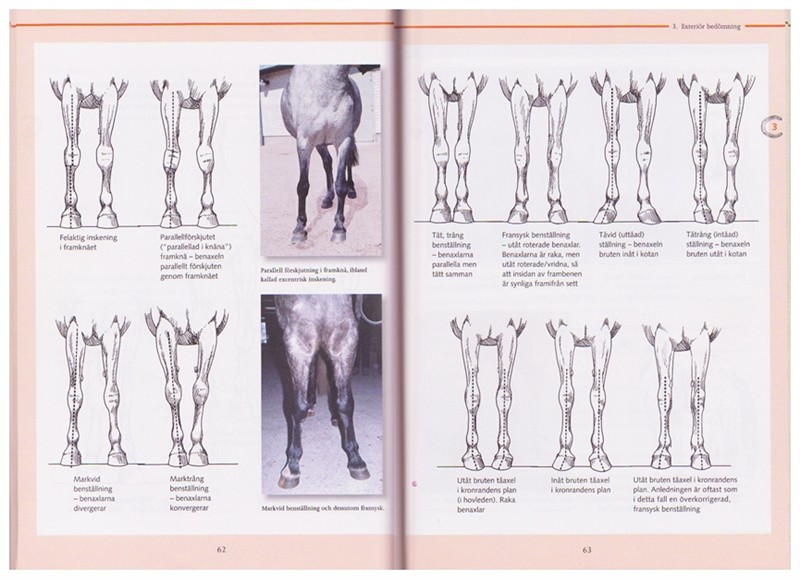
The horse's engine sits in the back, the angles that is talked about is how the pelvic angle affects the angle of the femur and it in turn affects the horse's ability to carry weight and pushing the horse forward. Power is transmitted via the lumbar spine - the part of the spine that allowes for some movement between the vertebrae. The legs are responsible to take the horse forward and the way the bones of the legs are stacked affects both movement patterns, hoof form and shock absorbing. Here's a spread that shows different leg conformation from the book The horse exterior by Lars-Erik Magnusson.


No horse is actually designed to carry any other weight than their own, be it trotters or riding horse. Since we choose to mount up and ride them, it is important to be observant of how the horse reacts to our training and to vary both training and ground we train on.

I would like to quote a farrier in Luleå, Bengt-Erik Källsenius. "You do not buy a retired trotter, you buy a bred trotter." Trotters can be very fine horses, provided that those who train them remember that they are bred to trot fast, and it has brought exterior customizations and a movement pattern that corresponds to the requirement.

Trotters are usually lower in height (about 155 cm), has a strong back to be able to handle the power coming from the hindquarter. A trotter usually begins its training in early years and made it in a reasonable manner based on the young horse it will build the body, both in terms of bone mass and muscular strenght. A trotter trained for racing, even if it does not measure up to race quality, can become a nice riding horse, with the advantage that it can also be harnessed and driven for a change.

I recommend Lars-Erik Magnusson's book The horse's conformation and a book in English The Horse Conformation Handbook by Heather Smith Thomas. And it's never wrong to take a crayon and mark the various joints, bones, etc on a real horse, and then measure the angles, lengths and widths. All that trains the eye and makes it easier to see the horse as it is.